
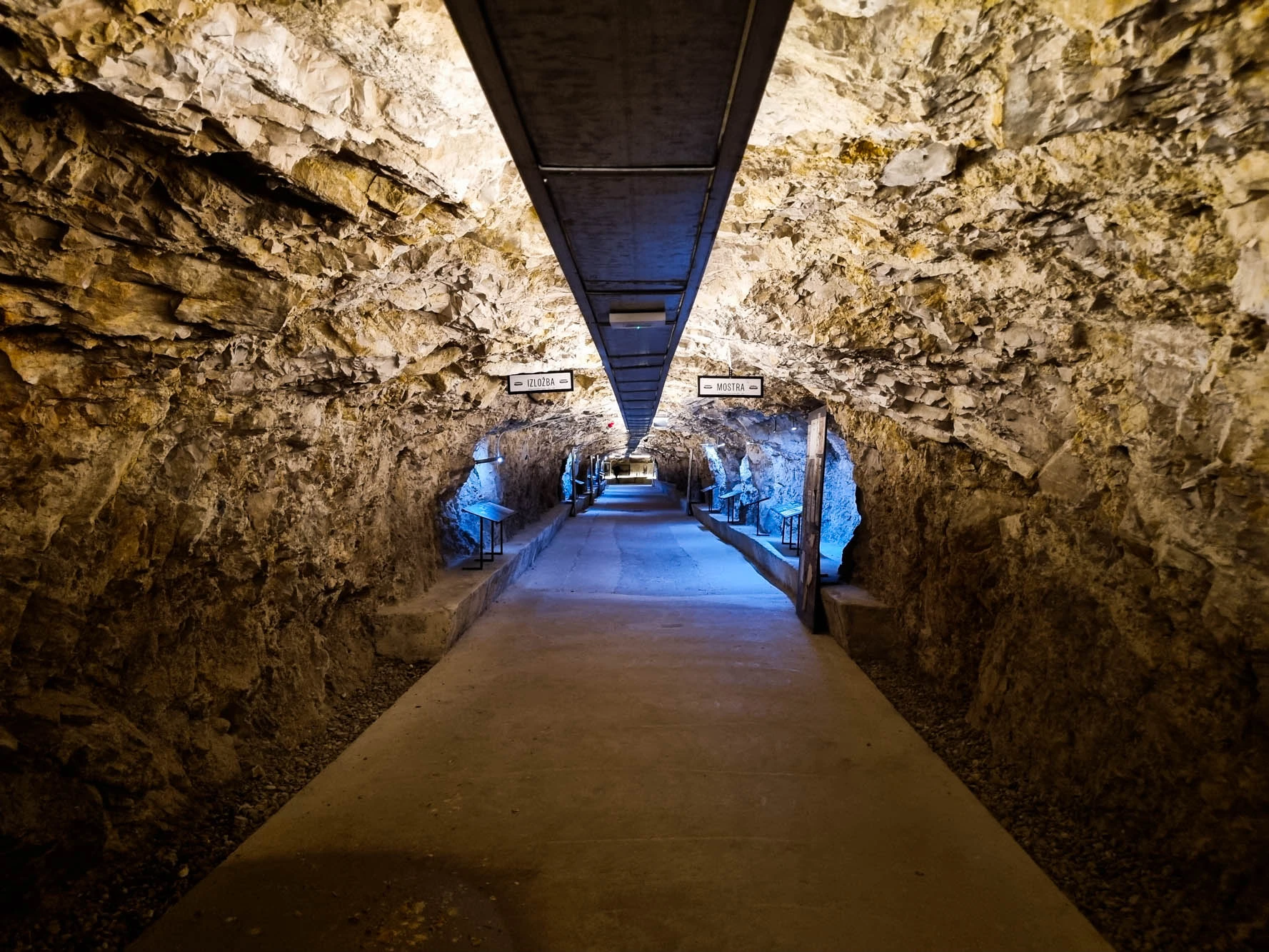
How did the Castle and Zerostrasse together shape the history of Pula?
Beneath Pula lies one city, while another rises above it. One made of stone, fortifications, and views of the sea, the other of tunnels. Zerostrasse and the Citadel are not two separate attractions, but a single story told on two levels, one that can only be fully understood by visiting them.

Pula Citadel and Zerostrasse Photo: Adria.fun
The central hill of Pula represents the oldest known point of settlement in the area of today’s city. The continuity of life at this location dates back to the beginning of the first millennium BC, when a prehistoric Histrian hillfort stood here, one of more than 400 such settlements in Istria and the first known settlement in the area of present-day.
This settlement was not a city in the modern sense, but rather a group of huts surrounded by circular dry-stone defensive walls. The cemetery was located outside the walls on the eastern and northeastern slopes of the hill, and several hundred graves were discovered during construction work along today’s Carrarina Street in the early 20th century.
Pula Citadel and Zerostrasse Photo: Adria.fun
After the end of the Second Histrian Roman War in 177 BC, the area was taken over by the Romans. It is assumed that a Roman military camp, a castrum, was built on the site of the former hillfort to control the conquered territory and the nearby maritime route. By the middle of the 1st century BC, the first true urban settlement was formed here, the Roman colony Colonia Pietas Iulia Pola.
During the Middle Ages, a city fortress known as castrum Polae stood on the hill. In the 13th century, it was granted to the powerful Pula noble family Sergii, who then adopted the name Castropola. Conflicts with the pro-Venetian Ionatasi family marked this period, with particularly violent events recorded during the night procession on Good Friday in 1271.
In 1331, the Venetians finally took control of Pula. The Castropola family was expelled from the city, and their medieval fortress on the hill was demolished.

Pula Citadel and Zerostrasse Photo: Adria.fun
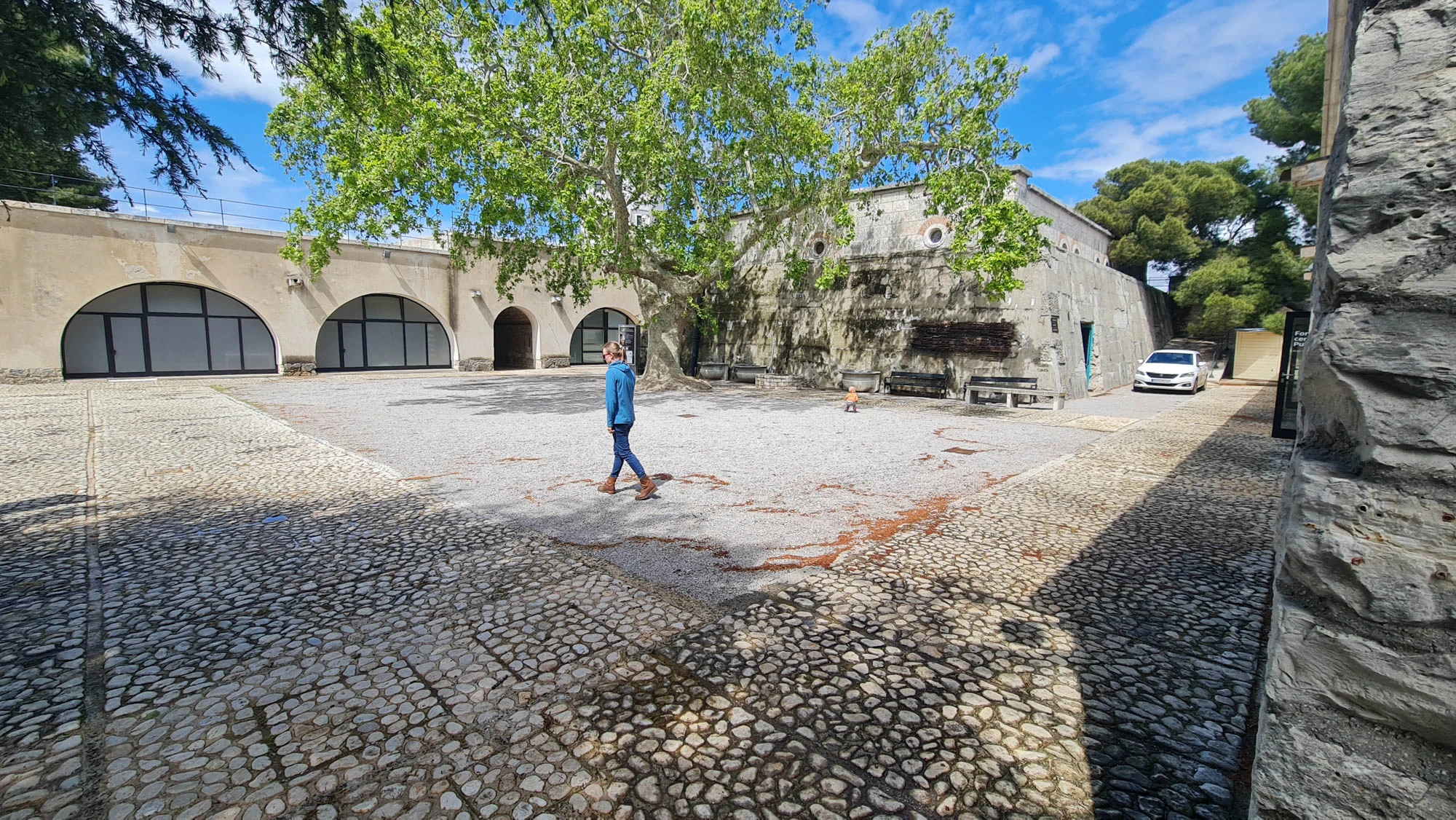
The present baroque Citadel fortress was built in the 17th century during Venetian rule. It was constructed in a star-shaped form adapted to contemporary artillery defence, positioned above the sea and near the freshwater spring Nimfej, which had been used since antiquity. From this location, it was possible to control the harbour, the city, and the approaches from land and sea.
Before the beginning of the First World War, Pula was the main naval port and an important military strategic centre of the Austro-Hungarian Monarchy. For the defence of the city, an extensive system of military facilities was built, stretching from the western to the eastern coast of Istria and including the island of Lošinj.
Pula Citadel and Zerostrasse Photo: Adria.fun
Within the city itself, Austro Hungarian authorities began systematic excavation of underground shelters beneath the hills of Pula. The aim was to provide protection for the population in the event of air raids and to create communication corridors and ammunition storage areas. Not a single hill within the narrow city centre was spared from drilling and excavation, resulting in a widely distributed network of underground tunnels.
The stability of the hill, its elevation, and its continuous military function through the centuries were the key reasons why the Austro-Hungarian army decided in the early 20th century to excavate the underground tunnel system directly beneath the Citadel.
Pula Citadel and Zerostrasse Photo: Adria.fun
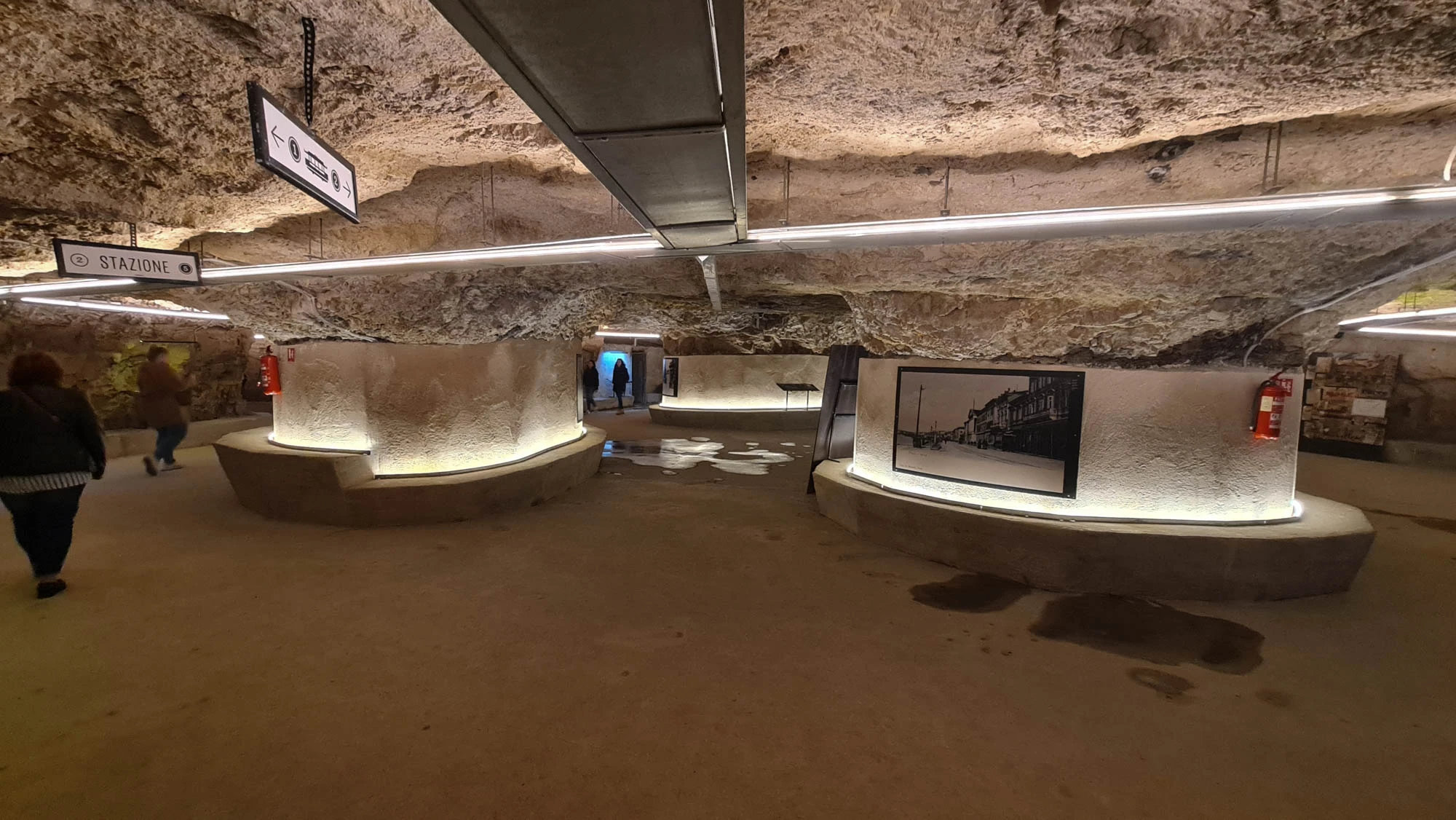
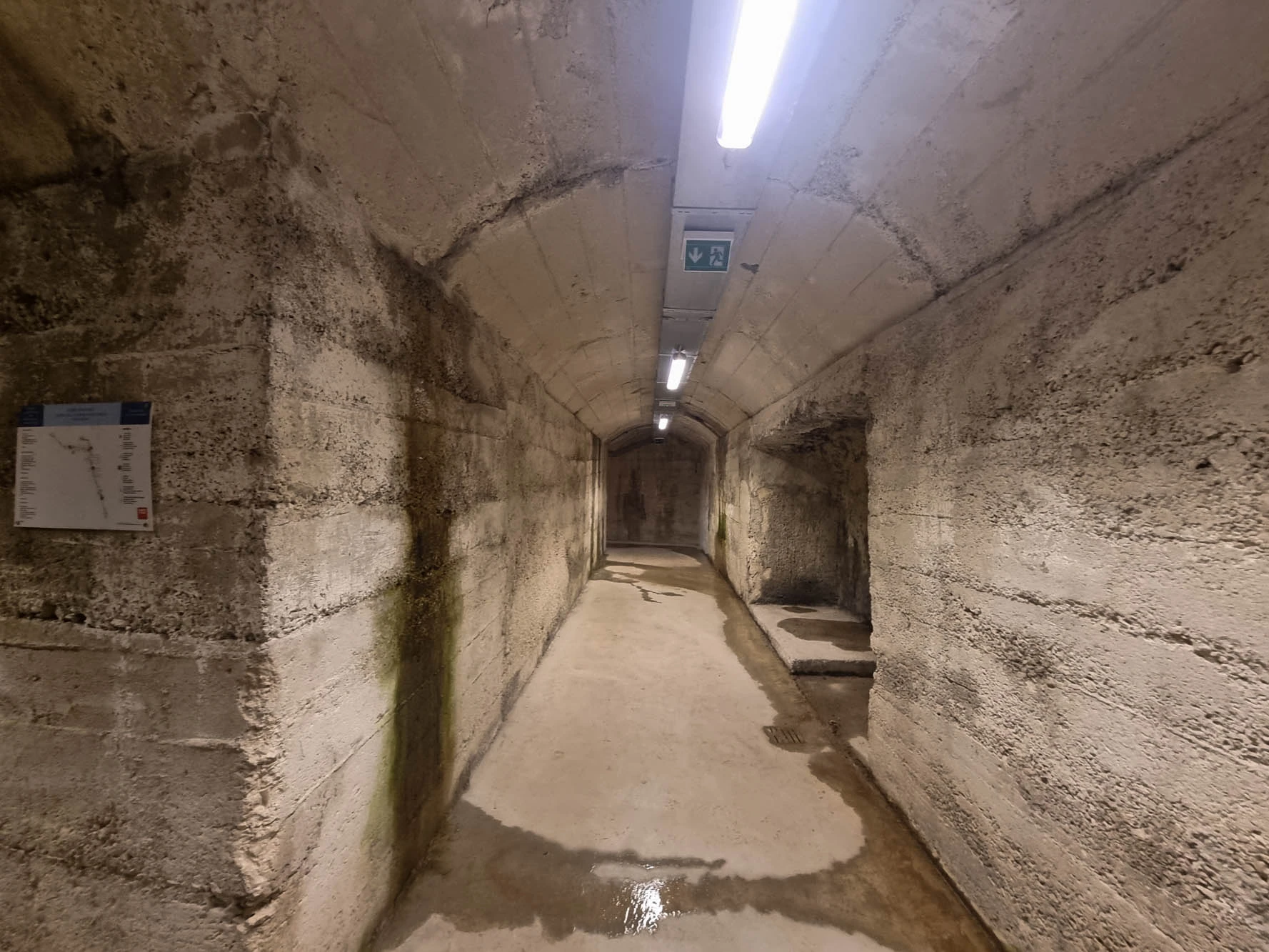
Beneath the central city hill, shelters were built on two levels. One lies directly below the Citadel, while the other extends along its base and connects parts of the inner city centre. The lower level functions like an underground communication street and is known as Zerostrasse.
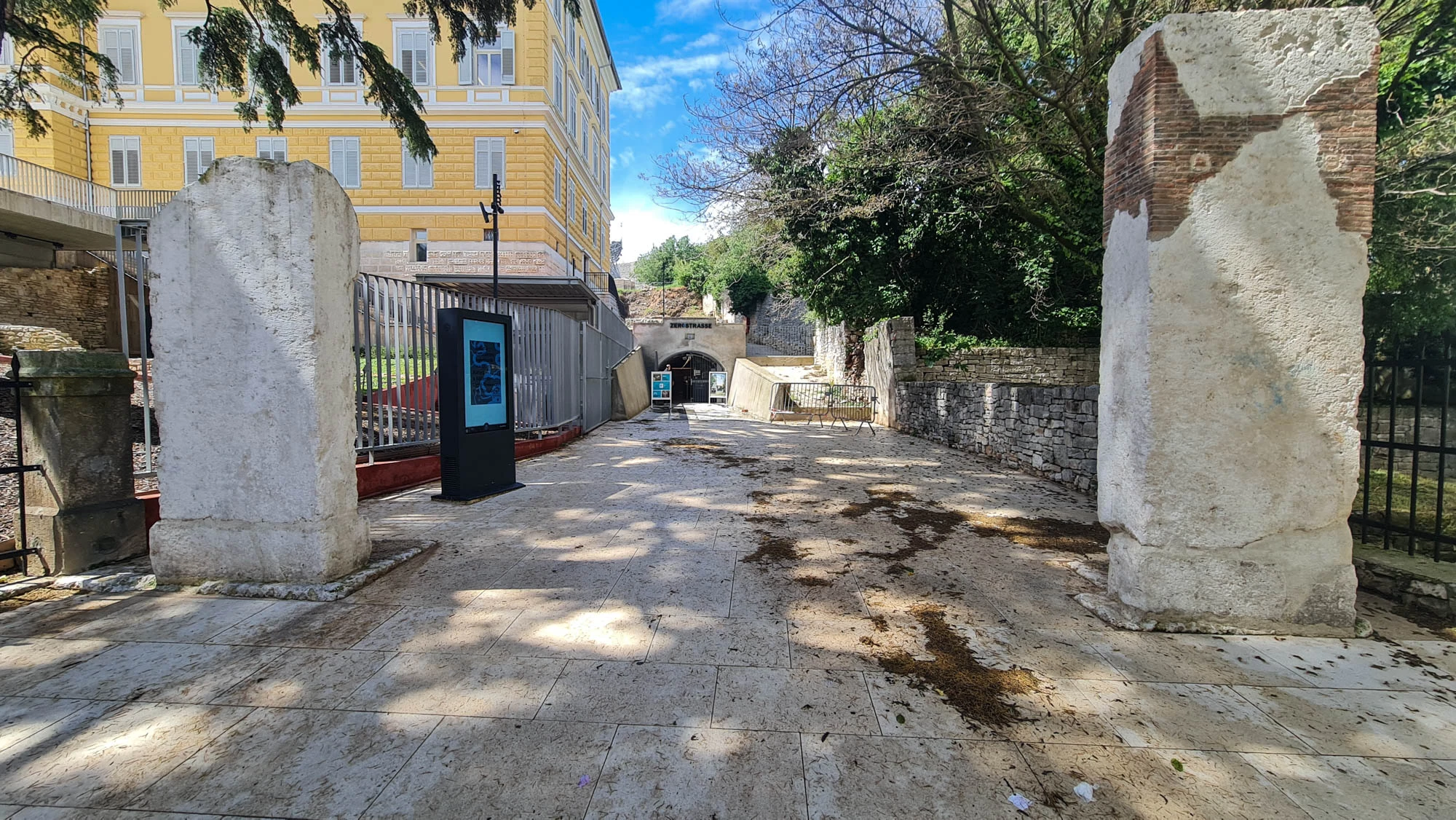
Zerostrasse is not a street, although its name suggests otherwise. It is an underground system of corridors connecting several directions within the historic city core. It has four entrances located on different sides of the hill, all leading through underground passages to a central space at the heart of the system.
The entrances were designed to allow natural air circulation throughout the network. The air temperature in the tunnels remains between 14 and 18 degrees Celsius throughout the year. The total length of the corridors is approximately 700 metres, their width ranges from 3 to 6 metres, and their height is about 2.5 metres. The space was intended to accommodate around 6000 people.
After the end of the First World War, the Italian authorities continued to use the existing underground shelters. The system was expanded and technically upgraded, and parts of the infrastructure remained in use during the Second World War and later.
Pula Citadel and Zerostrasse Photo: Adria.fun
Today, the Citadel houses the Historical and Maritime Museum of Istria, which serves as the central institution for preserving the military, maritime, and cultural heritage of the region. The underground section is connected by elevator, allowing direct movement from the tunnels into the interior of the fortress.
Together, Zerostrasse and the Citadel form a unique spatial and historical complex in which the continuity of settlement, defence, and strategic importance of Pula can be traced from prehistory to the 20th century.

Zoran Kovačić
I do miracles right away, but the impossible still takes me a little time!

Leave a Reply