
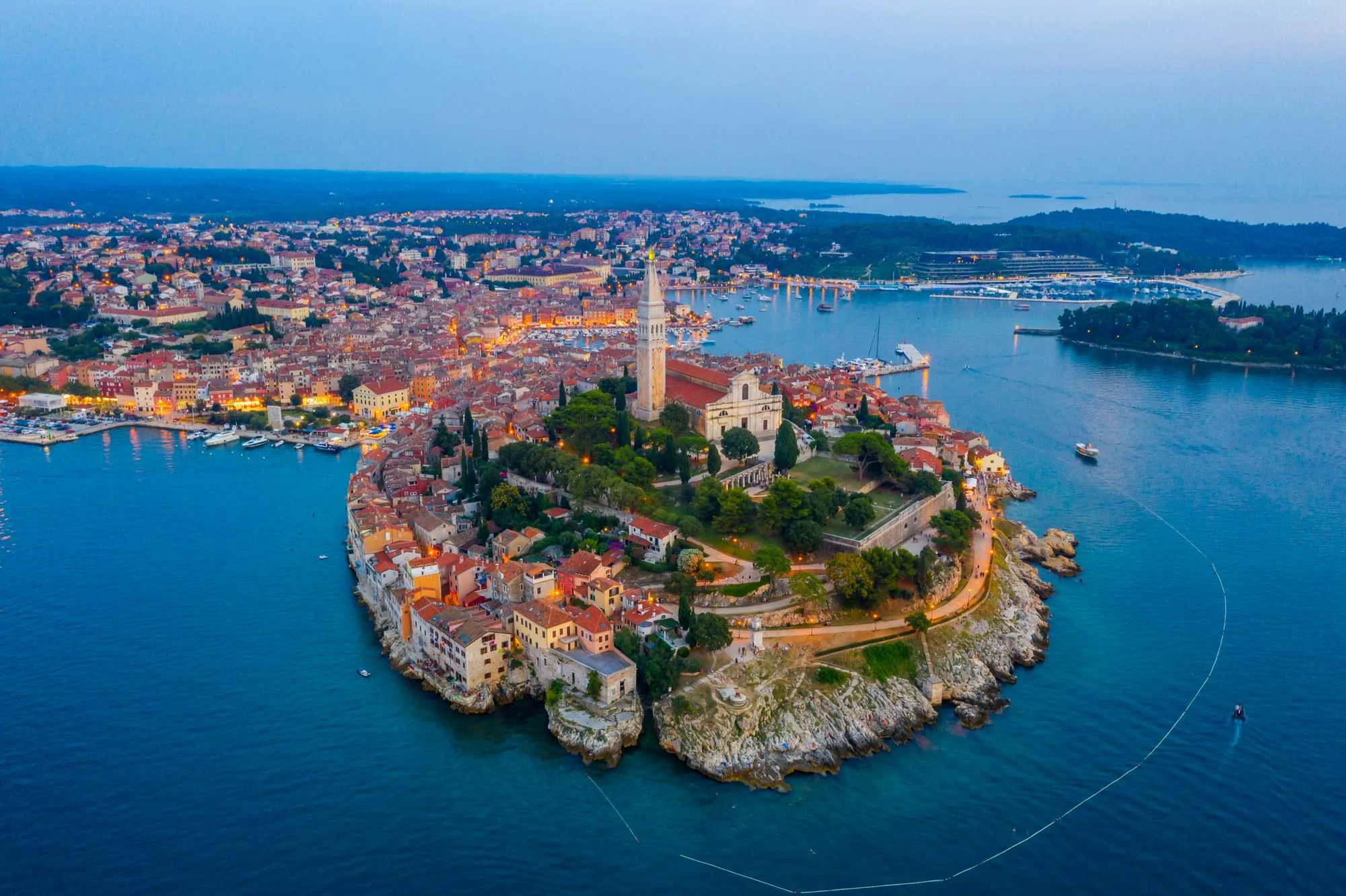
Do you know which church adorns almost every photo of Rovinj?
If you have ever stood on the waterfront and lifted your gaze toward the old town, there is a good chance your eyes were instantly drawn to the same sight as everyone else’s. Stone house next to stone house, narrow streets climbing as if escaping the sea, and above it all a single silhouette holding the whole of Rovinj together. The Church of Saint Euphemia is not only the most recognizable postcard motif, but also a place where legend, politics, devotion, and architectural ambition meet within the same frame, layer upon layer, across centuries.
On the hill that dominates the peninsula, where it feels as though the town ends in the sky, the church stands like a lighthouse made of stone. It is no coincidence that it is positioned at the very top. In times when towns were defended by height and visibility, the most important buildings were both spiritual symbols and strategic points, and Rovinj chose to tell its greatest story from above, from a place that overlooks both the open sea and the mainland.
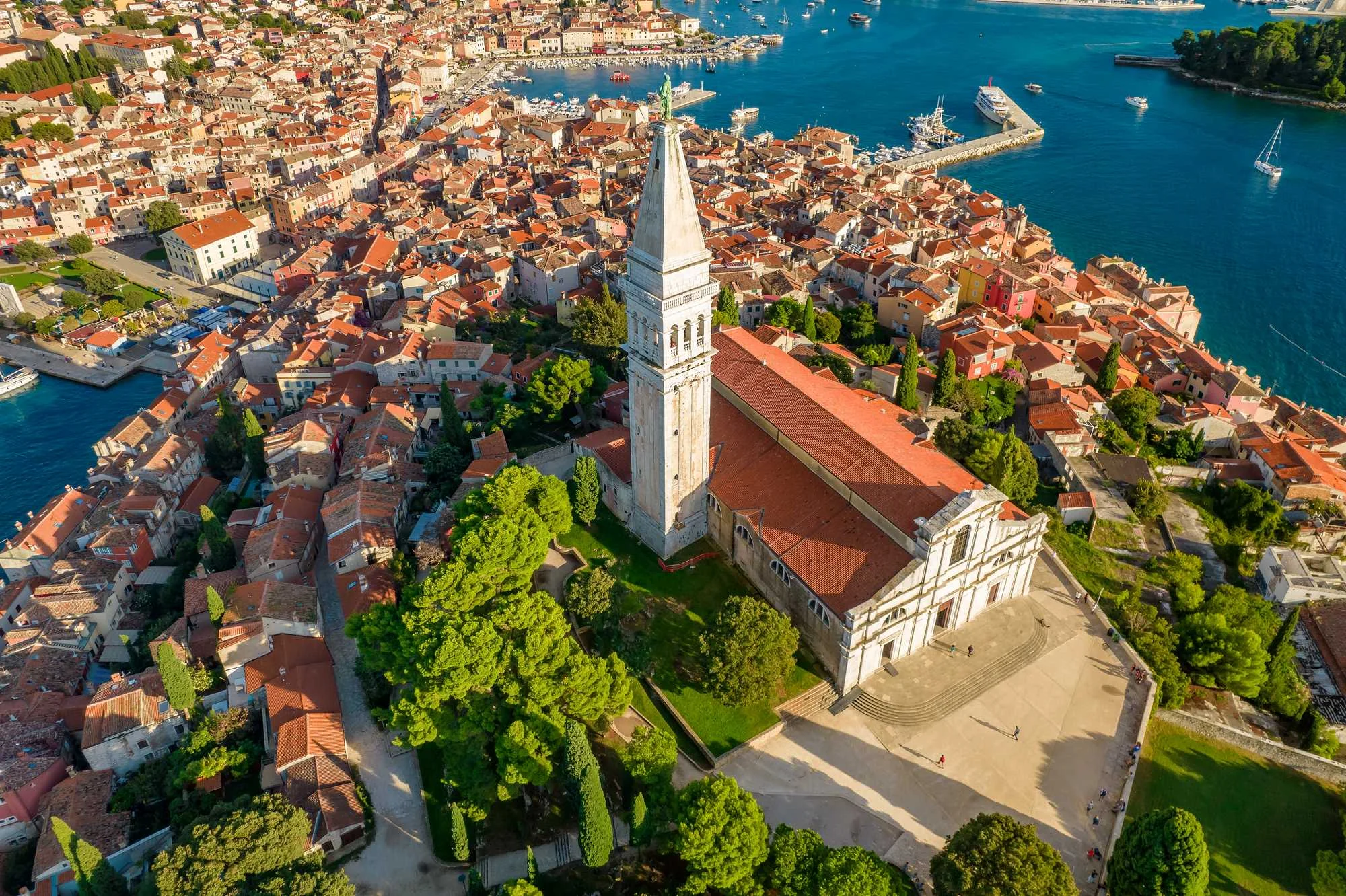
Church of St. Euphemia Photo: MazurTravel Depositphotos
BEFORE THE BAROQUE, BEFORE EUPHEMIA
Today, it is hard to imagine Rovinj without Saint Euphemia, yet historically, Saint George was venerated on this site for a long time. According to local records, a small church dedicated to Saint George stood on the hilltop until the tenth century, and he later remained co-patron of the parish, which is why his statue still holds a place on the main altar. This detail reveals how Rovinj does not erase older layers when new ones arrive, but rather builds upon them.
WHO WAS SAINT EUPHEMIA AND WHY IS ROVINJ HER TOWN?
Saint Euphemia was a Chalcedonian martyr, venerated in early Christianity, and today Rovinj celebrates her as its patron saint and symbol of the town. Her feast day, on September 16, is not merely a church date in Rovinj but also the town’s official day, a moment when spiritual tradition and civic identity openly overlap, just as layers of stone thresholds from different centuries overlap in the old town.
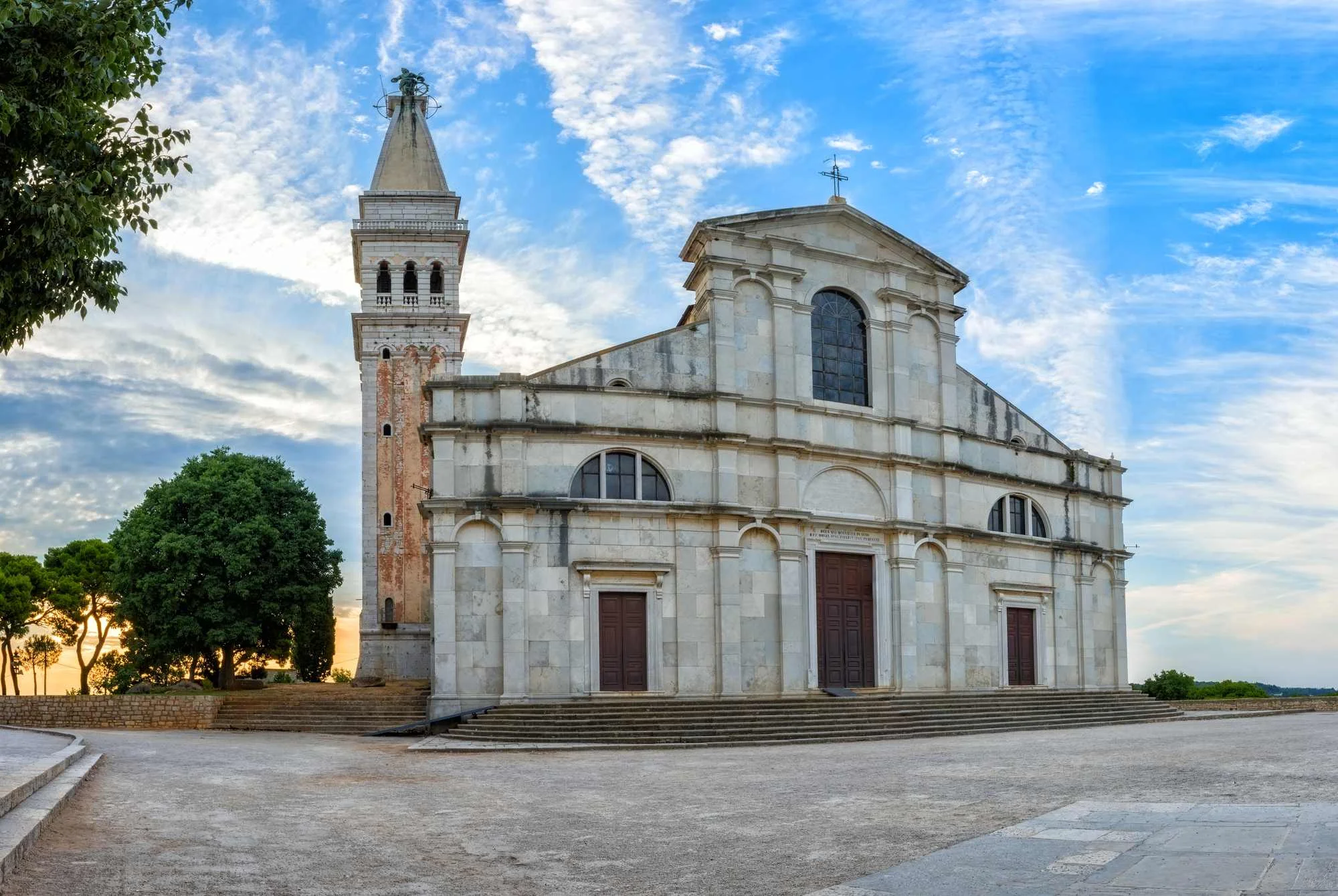
Church of St. Euphemia Photo: lugrin Depositphotos
THE SARCOPHAGUS THAT ARRIVED BY SEA
The most famous motif of Rovinj is neither the bell tower nor the façade, but what is kept inside. The church houses the sarcophagus containing the relics of Saint Euphemia, traditionally linked to the year 800 as the moment of its arrival in the town. The story says the sarcophagus sailed across the sea like a stone vessel, and that people tried in vain to move it until, according to legend, help came from above.
It is interesting that sources also emphasize the material nature of the relic itself. The relics are preserved in a Roman sarcophagus associated with the sixth century, with later adaptations, which gives the entire story an additional archaeological dimension.
THE BAROQUE CHURCH ROVINJ WANTED: CONSTRUCTION FROM 1725 TO 1736
The present church is largely the result of a major reconstruction and rebuilding in the eighteenth century. The key period spans from 1725 to 1736, when the monumental Baroque structure in Venetian style was created. The project is associated with the Venetian architect Giovanni Scalfarotto, with contributions by Giovanni Dozzi, often cited as proof that the community cared not only to have a church, but to have one that reflected its sense of prestige and beauty.
The dimensions of the building explain why, once inside, you feel as though you have entered a ship turned toward the sky. It is said to measure about 51 meters in length and 30 meters in width, with the central nave rising to around 17 meters, which was monumental for Rovinj then and remains so today, surrounded by a sea of smaller rooftops and narrow streets.
An important detail is the façade, dated in available descriptions to 1883. This means that although Baroque at its core, the church presents to the town a later architectural signature.
THE BELL TOWER EVERYONE COMPARES TO VENICE
When someone says “Rovinj in a photograph,” they often mean the bell tower of Saint Euphemia. It is no surprise, since it is openly compared to the campanile of Saint Mark’s Basilica in Venice. Literature states that it was built between 1654 and 1680 according to the plans of Antonio Manopola, thus predating the Baroque church as you know it today.
At the top of the tower stands a statue of Saint Euphemia that rotates and shows the direction of the wind, making the bell tower not only a symbol but a living instrument of the town, constantly listening to the bora and the sirocco. Its height is most commonly cited at around 60 meters, and in some tourist descriptions at 62 meters, yet in any case, it is a dominant structure that explains why the tower is visible from almost everywhere, and why photographs seem to seek it out even when you did not plan to include it.
WHAT AWAITS YOU INSIDE?
The church is three aisled, built upon earlier layers, and its content is not only liturgical but also cultural. Descriptions emphasize that it preserves artworks and objects from different periods, including Gothic sculptures from the fifteenth century and paintings from the sixteenth and seventeenth centuries. This is typical of major Adriatic churches. They were not created in a single day, but gathered vows, gifts, and the tastes of their people over centuries.
And yet, everything ultimately returns to the sarcophagus. When you stand before it, you realize that Rovinj did not bind itself to Euphemia only because she is its patron saint, but because her presence in the town became a story that can be seen, absorbed with the eyes and told to anyone who enters the church for the first time.

Zoran Kovačić
I do miracles right away, but the impossible still takes me a little time!
Leave a Reply