

A guide through southern Albania! Here’s what to visit after Tirana, Lake Komani, Shala and Berat
After exploring northern and central Albania, from the Albanian Alps to Tirana, Lake Komani, Shala, and Berat, it is time to continue our journey south. This part of the country offers different landscapes, rhythms, and scents. Here, rivers become wider, history even deeper, and the coast slowly transforms into a series of coves, islets, and hidden corners that do not seek attention but easily hold it.
Southern Albania is not a destination, but a continuation of the same story, the one about a land that connects wilderness and silence, sea and mountain, stone and water.
TOMORRI, BOGOVË AND THE LAKE VALLEY
The journey begins at the foot of Mount Tomorr. For many, it is just a mountain, but for the local people, it is sacred ground. While the peaks stand like guards above the Berat region, below lies the village of Bogovë. There, water bursts from the rock in the form of a cold, clear waterfall. A short forest trail leads to it, just enough to clear your thoughts.
Further east, among rolling hills, lies the valley of lakes near the town of Belsh. More than thirty small lakes are scattered across the landscape. Some are overgrown with reeds, some have wooden piers, and some are just blue patches in the middle of greenery: no crowds, no signs, just the feeling of being far away from everything.
APOLLONIA AND BYLLIS
Near Fier, above the plain, stands the ancient city of Apollonia. Once an important ancient city, today it is an archaeological park with the remains of temples, colonnades, and a Roman theatre. No big signs or interactive panels, just a walk through time among pine trees and grass growing where philosophers once sat.
Across the river, on a high plateau, rises Byllis. Less known but still powerful in impression. An Illyrian city, mosaics from the Late Antiquity period, and a stone theatre overlooking the valley of the Vjosa River. All you hear here is the wind and the occasional stone shifting underfoot.

Byllis, Photo: Ollirg, Dreamstime
PËRMET, BENJË AND VJOSA
Përmet is a quiet town on the river, known for its food, flowers, and calmness. Its closeness to the Vjosa River gives it a rhythm that cannot be measured by hours. Nearby, near the village of Benjë, thermal springs emerge from the ground. The water is mineral-rich, steam rises among the rocks, and above it all stands an old Ottoman bridge. Altogether, it looks like a scene from a forgotten travelogue.
POGRADEC AND LAKE OHRID
To the east, near the border with Macedonia, lies Pogradec. A town that does not need to say much. It is enough to sit by Lake Ohrid, look into its calm surface, and watch the day pass. Everything here moves slowly, but that is exactly what you need after the road.

Benje, Photo:Abenteuer Albanien, Usplash
TEPELENA AND THE VALLEY
Tepelena is not large, but it stands in a strategic place, above a valley, at the confluence of rivers. The fortress that dominates the town reminds one of Ali Pasha of Tepelena, a man who once ruled this region like a small sultan. Today, from that fortress, you see only mountains and roads disappearing behind curves.
VLORË, SAZAN, KARABURUN AND NARTA
Vlorë brings the first real contact with the sea. While the town has its rhythm, the real discovery lies across the water. From the harbour, boats depart toward Sazan Island and the Karaburun Peninsula. Once military zones, today wild and rocky landscapes accessible only by sea.
On land, to the north, lies the Narta Lagoon. Shallow, quiet, important for birds. In its centre, the island of Zvërnec with an Orthodox monastery that looks as if it was forgotten in time. A wooden bridge leads to it, and the atmosphere is quiet, almost sacred.

Narta lagoon and Zvernec island, Photo: Saxanad, Depositphotos
LLOGARA AND THE COAST TOWARD THE SOUTH
Driving through Llogara National Park means entering a different climate. Pine trees, freshness, then a sudden view of the sea. Below, the Ionian coast. The road descends toward places like Himara, Dhërmi, and Qeparo. White stone, olive trees, old bell towers. Everything seems to move in its rhythm.
GJIROKASTËR AND THE BLUE EYE
On the way south, just before Saranda, lies Gjirokastër, a town carved into a slope, known for its stone roofs, Ottoman architecture, and narrow cobbled streets. Often called the city of silver roofs, because of the way light falls on the slate tiles of the houses climbing up the hill like steps.
The castle that dominates the town offers a view of the entire Drim Valley, and inside it is a military museum with tanks, cannons, and a history that was not always quiet. Houses like the Zekate family residence are open to visitors and offer insight into the daily life of another era, of large families, stone staircases, and views that reach back through centuries.
A few kilometres away, near the village of Muzinë, lies the Blue Eye, or Syri i Kaltër. A spring of incredibly clear water, turquoise in colour and of unknown depth. You look at it and realise that nature still knows how to surprise. Swimming is not recommended, but the view is worth every kilometre.

Blue eye, Albania, Photo: Carla Forgiven Unsplash
SARANDA, KSAMIL, AND TONGO ISLAND
We have all heard of Saranda. A town in the far south of Albania, facing Corfu, is often mentioned when talking about holidays on the Albanian coast. Evening walks along the promenade, seaside restaurants, boats swaying in the harbour, all already familiar. And we all know Ksamil. White sand, shallow waters, a few islets you can reach by boat, and even walk to during low tide. These are the photos that circle every year, the sea in colours that do not need description because you already know them well.
Among them is Tongo Island, the southernmost point of Albania, where the sea flows into the Greek border.
BUTRINT
At the very south lies Butrint, a place that is at the same time an archaeological site, a national park, and a nature reserve. A city built by the Greeks, expanded by the Romans, defended by the Byzantines, and fortified by the Venetians, today it preserves layers of history beneath the tree canopies and along the shore of the lake that shares its name.
Here you will find the remains of a theatre from the third century before Christ, Roman baths, a baptistery, a basilica, mosaics, and a view of the lagoon that connects the land to the sea. On a nearby hill still stands Ali Pasha’s castle, built in the nineteenth century, with a view that follows the border between present-day Albania and what was once a Roman province.
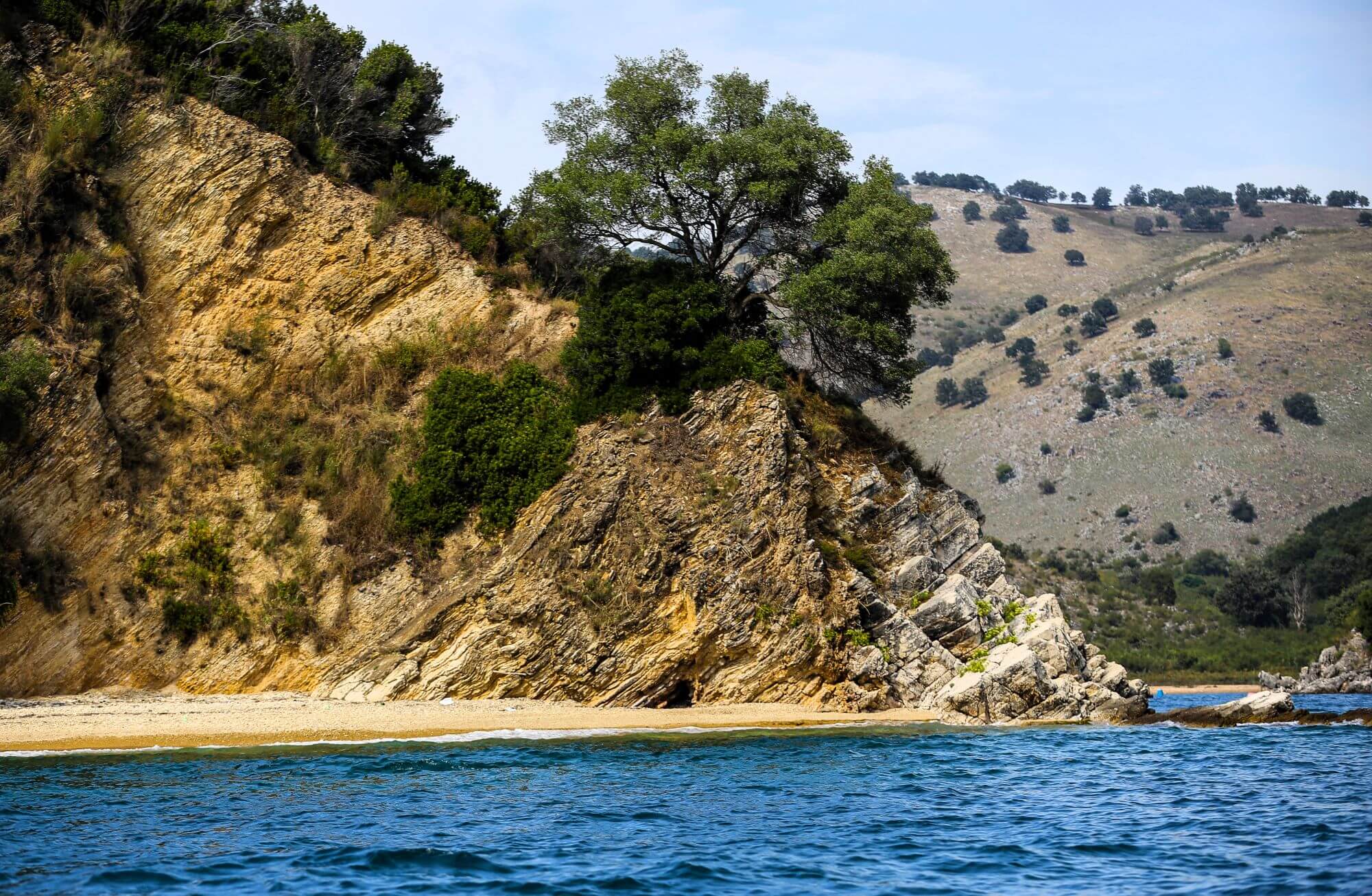
Tongo, Albanija, Photo: Von Fation Plaku, CC BY-SA 4.0
NO END, ONLY CONTINUATION
Travelling through southern Albania is not a conclusion, but an extension of the story that started in the north, through mountains and towns. You do not arrive here to finish, but to stay a little longer. Maybe on a cliff, maybe by a river, maybe in the shade of an olive tree. If you have not yet, here is your chance to explore the north…

Ahmed Taha
Peace, love and music! ☮️
Leave a Reply